
The last thing I expected while playing Doom: The Dark Ages was to be reminded of Halo 3. Yet, halfway through a recent hands-on demo with id Software's gothic prequel, I found myself mounted on a cyborg dragon, unleashing a torrent of machine-gun fire across the hull of a demonic battle barge. After destroying the vessel's defensive turrets, I landed my winged beast atop the ship and stormed its lower decks, reducing the entire crew to a crimson pulp. Moments later, the war machine was finished, and I burst through its hull, leaping back onto my dragon to continue the crusade against Hell's mechanized legions.
Fans of Bungie's landmark Xbox 360 shooter will instantly recognize the structure of Master Chief's assault on the Covenant Scarab. While the Hornet helicopter is replaced by a holographic-winged dragon and the laser-firing mech by an occult flying ship, the core experience remains: an aerial attack that transitions into a devastating boarding action. Surprisingly, this wasn't the only moment in the demo that echoed Halo. While The Dark Ages' combat is unmistakably Doom, the campaign's design carries a distinct "late-2000s shooter" vibe, thanks to its elaborate cutscenes and emphasis on gameplay variety.
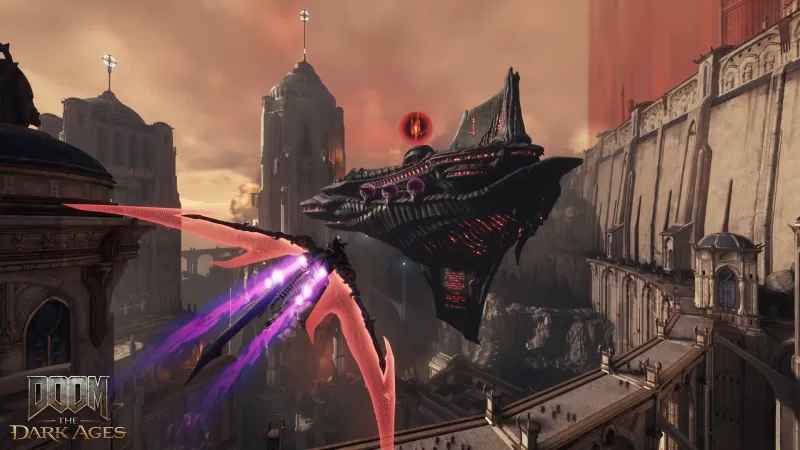
Over two and a half hours, I played four levels of Doom: The Dark Ages. Only the first—the campaign opener—resembled the tightly paced, meticulously crafted level design of Doom (2016) and its sequel. The others involved piloting a colossal mech, flying the aforementioned dragon, and exploring a vast battlefield littered with secrets and powerful mini-bosses. This marks a significant departure from Doom's traditional focus on mechanical purity, feeling more akin to Halo, Call of Duty, or even classic James Bond games like Nightfire, which thrive on scripted set-pieces and mission-specific novelty mechanics.
This is a fascinating direction for the series, which once made a definitive U-turn away from such concepts. The cancelled Doom 4 was reportedly designed to resemble Call of Duty, not just in its modern military aesthetic but also in its emphasis on characters, cinematic storytelling, and scripted events. After years of development, id Software concluded these ideas didn't suit the franchise, scrapping them for the more focused Doom (2016). Yet, in 2025, they reemerge in The Dark Ages.
The campaign's rapid pace is punctuated with new gameplay ideas reminiscent of Call of Duty's biggest set-pieces.
My demo began with a lengthy, elaborate cutscene reintroducing the realm of Argent D'Nur, the opulent Maykrs, and the Night Sentinels—the knightly brethren of the Doom Slayer. The Slayer himself is portrayed as a terrifying legend, a walking cataclysm. While this lore will be familiar to those who pored over the previous games' codex entries, its presentation here feels new, different, and distinctly Halo-like. This continues into the levels themselves, with NPC Night Sentinels scattered throughout the environment like UNSC Marines. While they don't fight alongside you (at least in the levels I played), there's a stronger sense that you're part of an army—like Master Chief, you are the unstoppable spearhead of a larger force.
The introductory cutscene features substantial character work, leaving one to wonder if Doom truly needs it. I've always appreciated the earlier games' subtle approach to storytelling and would have preferred The Dark Ages to continue telling its tale through environmental design and codex entries, reserving cinematics for major reveals as in Eternal. While I have reservations, the cutscenes thankfully know their place: they set up a mission and then vanish, never interrupting Doom's signature, relentless flow.
Interruptions come in other forms, however. After that opening mission—which begins with pure shotgun carnage and ends with parrying Hell Knights using the Slayer's new shield—I was thrust into the cockpit of a Pacific Rim-style Atlan mech to wrestle demonic kaiju. Next, I was soaring through the skies on that cybernetic dragon, dismantling battle barges and neutralizing gun emplacements. These tightly scripted levels create a significant gear shift, punctuating the campaign's breakneck pace with new gameplay concepts that recall Call of Duty's most memorable novelties, like Modern Warfare's AC-130 gunship sequence or Infinite Warfare's dogfighting missions. The Atlan is slow and ponderous, its skyscraper-high perspective making Hell's armies look like Warhammer miniatures. The dragon, by contrast, is fast and agile, and the shift to a wide-angle third-person camera creates an experience that feels worlds apart from classic Doom.
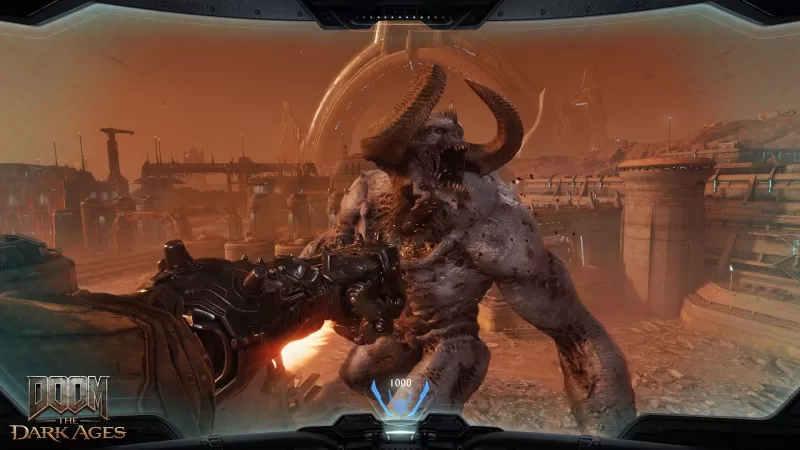
Many of the greatest FPS campaigns thrive on such variety. Half-Life 2 and Titanfall 2 are the gold standard. Halo's longevity is partly due to its rich blend of vehicular and on-foot sequences. But I'm unsure if this approach will work for Doom. As with Eternal, The Dark Ages is a wonderfully complex shooter to play—every second demands total attention as you weave together shots, shield throws, parries, and brutal melee combos. In comparison, the mech and dragon segments feel anemic, stripped-back, and almost on-rails, with combat engagements so tightly controlled they border on QTEs.
In Call of Duty, the switch to driving a tank or manning a gunship works because the mechanical complexity isn't far removed from the on-foot gameplay. But in The Dark Ages, there's a clear gulf between styles—akin to a middle-school guitar student trying to play alongside Eddie Van Halen. And while Doom's core combat will always be the star, when I'm pummeling a giant demon with a rocket-powered mech punch, I shouldn't find myself wishing I was back on the ground with a "mere" double-barreled shotgun.
My final hour of play saw The Dark Ages shift into another unusual but more promising guise. "Siege" refocuses on id's best-in-class gunplay but expands Doom's typically claustrophobic level design into a vast, open battlefield. Its geography shifts between narrow corridors and wide arenas, offering myriad pathways and combat spaces. The goal—to destroy five Gore Portals—echoes the multi-objective, complete-in-any-order missions of Call of Duty, but the grand scale of this map versus the tighter opening level once again evoked Halo's contrast between interior and exterior environments. Here, the novelty lies in placing Doom's excellent core systems within much larger spaces. You must reconsider the effective range of every weapon. Your charge attack covers distances the length of football fields. Your shield deflects artillery fire from oversized tank cannons.
Were these concepts always a bad fit for Doom, or were they only problematic when they resembled Call of Duty too closely?
The downside of expanding Doom's play space is that it can feel unfocused. I found myself backtracking through empty pathways, which seriously dampens the pace. Here, I wished The Dark Ages had leaned even further into Halo's playbook by integrating the dragon as a usable asset like a Banshee. The ability to fly across the battlefield, raining fire before dive-bombing into a mini-boss fight, would have maintained momentum and made the dragon feel integral. If such a level exists beyond what I played, I'll be thrilled.
Regardless of the full campaign's final shape, I'm fascinated that much of what I've seen feels like a resurrection and reinterpretation of ideas once deemed incompatible with the series. Very little of the cancelled Doom 4 was publicly shown, but a 2013 Kotaku report painted a clear picture: "There were a lot of scripted set pieces," a source stated, including an "obligatory vehicle scene." That's precisely what we get in the Atlan and dragon sections—mechanically simple, scripted sequences that recall the novelty vehicle levels of Xbox 360-era shooters.
In a 2016 interview with Noclip, id Software's Marty Stratton confirmed Doom 4 was "much closer to something like [Call of Duty]. A lot more cinematic, a lot more story... a lot more characters around you." All that was scrapped, making its return in The Dark Ages genuinely intriguing. This campaign is set to feature large boarding actions, lush cinematics, a broader cast of characters, and significant lore revelations.
The question now is: were those ideas always ill-suited for Doom, or were they just a bad fit when they too closely mimicked Call of Duty? Part of me shares the skepticism of the fans who once decried "Call of Doom," but I'm also excited by the prospect of id Software finally making that approach work by grafting it onto the now-proven modern Doom formula.
The bloody, beating heart of The Dark Ages remains its on-foot, gun-in-hand combat. Nothing in this demo suggested it won't take center stage, and everything I played confirms it's another fantastic evolution of Doom's core. That alone feels strong enough to carry an entire campaign, but id Software clearly has broader ambitions. I'm surprised some of the studio's new ideas feel mechanically thin, and I worry they might feel like contaminants rather than fresh air. But there's much more to see. These isolated demo missions will need the full context of the campaign. I eagerly await May 15th, not just to return to id's unparalleled gunplay, but to answer my curiosity: Is Doom: The Dark Ages a standout late-2000s-style FPS campaign, or a messy experiment?